We woke and began our walk out of Oviedo under a gray morning around 7:45am. The cool air was welcome but we hoped it might clear a bit for views before too long.
When leaving the town and beginning the Camino Primitivo, one has two popular choices for their first day. It is 13km (7.8 miles) to the small pueblo of Escamplero or 26km (15.6 miles) to the larger pueblo of Grado both of which have albuergues (hostels) or pensiones (more like a relaxed hotel). I figured the shorter day was a good option and would allow us to take a small side trip up to two World Heritage UNESCO sites on Mount Naranco as we made our way out of town (adding about 6.2km or 3.7 miles). This would be a total of about 11.5 miles for our first day.
The day before I made sure we walked the official Camino Primitivo route from the cathedral to our pension (Romero) so that when we left this morning we could just continue on it out of town. To take the side trip, we left the route before town ends and headed up hill through a winding neighborhood that gave us views back down into the heart of the city.
Clouds covered the summit of Mount Naranco as we made our way from sidewalks to road to a wooded path to visit both the Santa Maria del Naranco and San Miguel del Lillo iglesias nestled on the slopes of the mountain that has a height of just over 2,000ft. We arrived too early in the morning for either to be open (if a church is going to be open in Spain, it usually isn't until 10am or later), but it was interesting to walk around them and admire the architecture. Both were built in the 9th century and are in varying states of restoration (see uploaded photos).
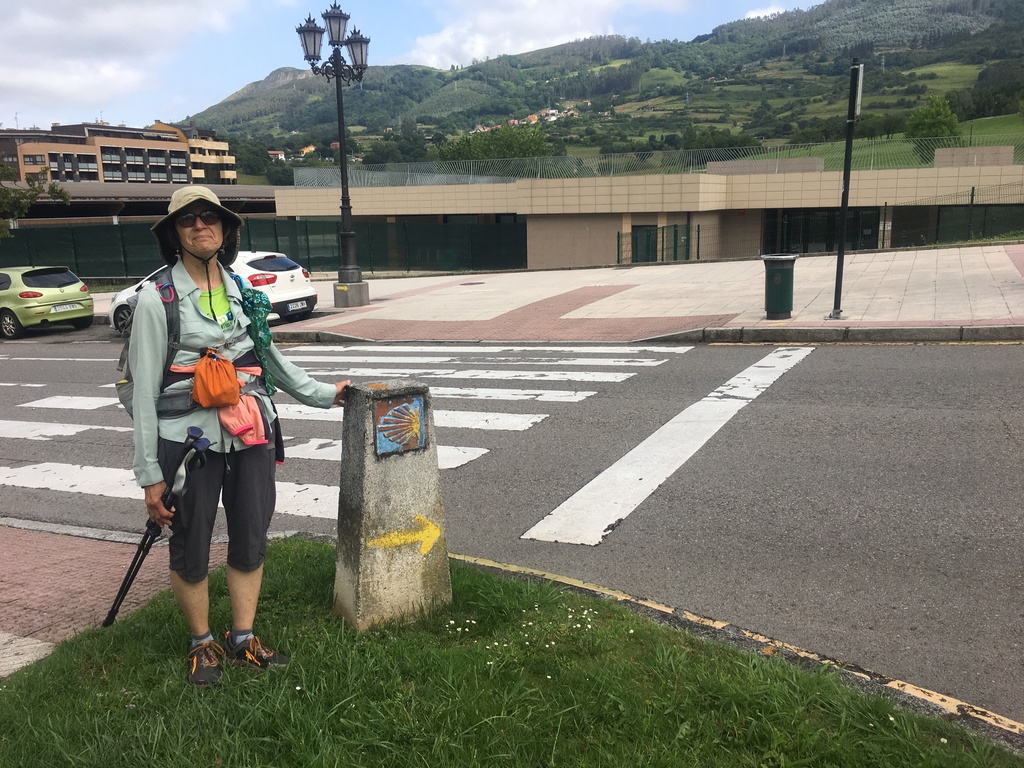
By 9am we were walking back down and reconnecting with the Camino to continue out of town. It was very easy to follow the route with the multiple bronze shells in the sidewalks at every junction and concrete markers once you left were further away from downtown. There was only ONE time that there should have been a shell and wasn't (crossing Calle Uria) but I have an app that I could check to make sure we turned the right direction and found a shell further up the street. In the region of Asturias, any bronze shell or concrete marker points the way by following the direction where the rays come together. Road signs and the region of Galicia is another story but that comes later...
Around 10:30am we reached our first stage marker with a map of the towns along the Camino and services provided in each one (just a bar versus a place to stay, for example). The area was still within the outskirts of town with apartments and urban parks but we could look ahead and see we were moving towards the countryside.
For me, it was at this point that walking a Camino in Spain became real. Up to this point, it was all something planned and imagined. Now I would actually be walking it and seeing how it would unfold for myself. Would it be as I had seen my mind, would it be more or even less?
For the next hour or so, we wandered up and along a mix f overgrown gravel and dirt roads that intersected wide open fields of grass and early corn and potato. Every once and awhile the path would connect with a route through a green tunnel in the forest lined with centuries old stone walls pocked with ferns and succulents. As we broke out onto another farm road, layered green hills rolled out in the distance dotted with tiled farm houses and weathered wooden barns. An occasional horse would look up from munching or a cowbell would ring from up on a slope above us.
Our first stamp of the day came from a tiny chapel as we passed through Llamaxuga, one of what would be many miniscule villages we would encounter on our journey. Nothing more than a few cobbled homes at least a century or two old, a chapel and a fountain if we were lucky with random blue and yellow shells attached to the sides of buildings to show us the way through so we didn't end up in someone's open barn next to a tractor.
There was a covered porch in front of the chapel, named Capilla Del Carmen, and we stopped and took off our packs. I had seen a small wooden door next to the closed doors of the chapel itself that said, "Sello-Stamp" and an arrow pointing. Opening the door, there was stamp and stamp pad with a little plastic box for leaving donations for the chapel. Smart. Many of the chapels and iglesias we would see would offer a stamp and/or have a small slot for donations. The Camino is not only a walk of faith but a great way to leave behind some lesser change you might be carrying in your pack for restoration or flowers for the altar on Sunday. Adding an accessible stamp ensured you would have more visitors than a chapel without. A bonus table and chairs definitely made an appealing stop even if you had only been walking for a short distance.
My mom had been fiddling with her pack up to this point and would be for a good portion of our first week on the trail. She had not walked much with it (maybe once) and was getting used to weight distribution and where things would go for easy access when she needed them. These are things that someone like myself who has spent a lot of time backpacking has dialed in but it was new for her. I was feeling bad as I had suggested she switch to the lighter Gossamer Gear pack over the smaller High-Tec one she had planned to bring because it seemed to be a nuisance but she eventually did get the hang of things.
Like many of the chapels we would see, you could peek through barred square openings in the main doors and look inside at the rows of simple wooden pews and decorated altar. Usually someone in town will have the keys and if you want, you can ask to sit in prayer inside. Most people, like us, would take a moment outside to be in silence with prayer or precious hopes for the Camino walk. Often there would be a posted prayer on the wall, sometimes geared towards a pilgrims journey.
Several more pilgrims came and went as we were there. As with the beginning of all long-distance trails, you could tell there was a mix of day hikers and pilgrims bound for Santiago. Pack size would vary or they would soon turn around while the rest of us continued.
It took us about two more hours to reach Escamplero, our stop for the day. The last mile or so was on road, some of which was a bit sketchy as you walk a thin shoulder. I suppose we were going to have to get used to that and it seemed most driver's would give us a wide berth.
In Escamplero, there is not much more than a restaurant with a pension above it (El Tendejon de Fernando) and a public albuergue managed by the same restaurant. Mom and I found a white plastic table on the patio in front of the restaurant and sat down. First, we each ordered a drink and toasted to making our first day. The view from here looked out over the valley and I could see how this would make a fine tourist stop on a road trip. It was Sunday and the place was filled with families and couples enjoying the afternoon (at about 2pm).
We had not made reservations ahead of time and inquired about the pension which turned out to be full so we paid 6 euro each and received a set of disposable sheets to take with us to the albuergue which was a little further up the road. I then asked about ordering dinner and was told we had a little while to order as they stopped serving at 5:30pm (it was about quarter to 4). This was a common occurrence for our trip, a restaurant or bar would be open until about 4 or 5pm, then close for a few hours to open again around 7 or 8pm. If you wanted to eat out, it was before or after this time frame. We would often eat at 2pm or so and then again around 7 or 8pm.
After enjoying some local dishes like fabada asturiana and having fun with the cider "machine" that poured my cider into my glass for me, we walked over to the albuergue to settle in for the night. I will make a note here before leaving the restaurant. If you have ever read a Rick Steves book, you know he will tell you that if you don't want to pay for your water at a restaurant abroad, you have to specifically order it "from the tap". Well, I did that only once in Spain and it was here at this restaurant. Let's just say a laugh escaped from my waiter and then he said, "Okay," like I was definitely some tourist. I never asked for it that way again. Even though the water is totally fine in Spain (first world country) everyone gets their water out of a bottle unless they are at home. As a solution, I usually ordered "agua con gas" (seltzer water) to justify paying for my water each time and it was a break from the water we were drinking while walking.
Our albuergue was basic but clean and relatively full for the night. We got there early enough to score two bottom bunks. This is where our routine that we would have for most of our trip began. We would unpack the things we needed for sleep like a liner bag, toiletries and sleep clothes. There would be a shower and washing of a few items of clothing like socks, underwear and shirt so they could hang and dry out along with the towel we carried. Then the rest of day was spent relaxing before going to bed around 9pm depending on how much there was to do in town which for Escamplero was not a lot. I think some of our roommates had gone back into the restaurant/bar but I opted to just relax at the albuergue for the night. I did chat with a couple across from us who were both carrying the Six Moon umbrella and I wanted to know if they had brought it with them. They had but had checked their bags. I was a little jealous but sure that my department store purchase would be okay for what I needed it for on this journey.
Before we went to bed, I talked with my mom about our distance for the next day. To walk to the next town with lodging was Grado (13km/7.8m) or we could continue a bit past to La Doriga (22.2km/13.3m). Our plan had always been to try and average 12 miles a day and not stopping in Grado would help us stay "off stage" as most people stop there. We decided we would see how we felt once we got to Grado and then call ahead to La Doriga and see if reservations were possible


Comments
You must login before you can comment.